Wednesday, August 8, 2012

Miss Atomic Energy of 1948 is Still Going Strong

Janis Paige_Miss Atomic Energy_1948
Indestructible entertainer Janis Paige, who will be celebrating her 90th birthday next month with a one-woman show at San Francisco’s RRaz Room, was once known (albeit briefly) as Miss Atomic Energy. The following is a short history of this little known chapter in Cold War popular culture.
In September of 1948 Ms. Paige, a Tacoma, Washington native and film actress, was scheduled to return to her home state to lend some star power to the first annual Atomic Frontier Days festival in Richland. Her title of Miss Atomic Energy was attributed in the press to an apparently spontaneous vote by “several thousand workers at the atomic-energy plant.” But it was more likely that the honor was the creative result of studio flacks looking for a story to go with their amazing publicity picture (as seen above and shot by the late great Floyd McCarty).
Janis Paige_LAT_1948 copy
On September 1, 1948, the Los Angeles Times announced Ms. Paige’s news with a photo caption reading “SHE’S ATOMIC – Actress Janis Paige chosen for honor at celebration in Northwest.” The article went on to state:
Radioactive or not, Janis Paige, Warner Bros. actress, has been named Miss Atomic Energy by several thousand workers at the atomic-energy plant in RIchland, Wash., it was announced yesterday.
So, Miss Paige will fly to the northern city Friday to be a guest in an Atomic Frontier Day celebration which also will be attended by members of the government’s Atomic Energy Commission and other officials
The actress will crown the local queen, ride in the parade and be a guest at a horse show and barbecue.
Janis Paige_LAT_Txt copy 
In the September 6, 1948 edition of the Union Bulletin of Walla Walla, Washington, Ms. Paige was mentioned briefly in a story about Barbara Wiltz, “tall shapely blonde…who was crowned queen of the first annual ‘Atomic Frontier Days.’ The article notes that “movie actress Janis Paige took part in the ceremony.” A week later, the same newspaper carried a photo of the crowning under the headline “Queen of the Atomic City.” Although, it is impossible to tell from the poor quality image below, Ms. Paige is to the left of the “Queen.”
Queen of Atomic City copy 
We’re not sure whatever became of Ms. Wiltz, but Janis Paige continued her remarkable career path with roles in One Sunday Afternoon (1948), This Side of the Law (1950),  Silk Stockings (1957) and many other films and television series. CONELRAD wishes the former Miss Atomic Energy a very happy birthday!

APPENDIX: Text from the Back of the 1948 Floyd McCarty Publicity Photo
“Security at the Richland, Washington Atomic Energy Plant has been lifted long enough to reveal that the atomic workers there have selected Janis Paige as "MISS ATOMIC ENERGY." Janis will fly to Richland, Washington to reign over the Atomic Frontier Celebration, Sept. 4-6, commemorating the founding of Richland's Atomic Energy Plant. Here Janis demonstrates the reason she was accorded the honor -- her thorough knowledge of higher mathematics. Janis will soon be seen in Warner Bros.' ONE SUNDAY AFTERNOON.”

Wednesday, April 25, 2012

Off-Season: Killing Time at Mount Weather

Cvr-CU
The massive top secret government relocation site known as Mount Weather (aka the Classified Location) has been featured in political thrillers since at least 1962 (its debut was as the thinly disguised “Mount Thunder” in the novel Seven Days in May by Fletcher Knebel and Charles W. Bailey II), but some of its more mundane, real life functions may surprise readers. Indeed, CONELRAD recently discovered a “Weekly Schedule of Activities” for the legendary Cold War super fortress that has all of the excitement of a corporate retreat agenda. But what makes this document of particular interest is that it is from the extremely tense early 1960s when one would have thought more would have been going on. But perhaps even government bunkers have off-seasons.
harvard club
If nothing else the memo proves that the Classified Location had a war room and showed cool old (even for 1961) propaganda movies. For the weeks covered in the schedule, the Raymond Massey-hosted Seconds for Survival (1959) screened at 10:45 AM on November 7, 1961 and the NBC television documentary Nightmare in Red (1955) ran at 9:00 AM on the following day. There are also unidentified movies that ran at night which may have been from an entirely different genre (one not featuring the likes of Mr. Massey). 
Classified Location-CU-2
And what taxpayer funded getaway would be complete without church services and a bus ride home? 
Church Services
Mount Weather Weekly Activities: 1961

Figures mentioned in the document:

Walter L. Mazan (1921-1991)
Project Director, Programs
Classified Location

Frank J. Muckenhaupt (1922-1992)
Director, Operations Classified Location

Jack R. Scott (1921-2008)
Director, Classified Location

J. Leo Bourassa (1917-2000)
Deputy Director, Classified Location

George Grace,
Project Director, Emergency Operations, Classified Location

E. McKay,
Project Director, Plans and Readiness, Classified Location

G.H. Chandler Tredick (? – 1984),
Director, Administration and Security, Classified Location.

William Kittel,
Director Passive Defense Office Corps of Engineers

Joseph P. Sahm (1914-1991), Technical Director, U.S. Army Interagency Communications Agency

E. Allen Aime,
Meteorological Consultant, Classified Location

Dr. Joseph D. Coker,
Director National Resource Evaluation Center

John Richardson,
Operations Classified Location

Source: National Archives, College Park, Maryland. Records Group 306, Records Pertaining to Emergency Planning. Box 3, Folder O-113, OCDM / CL Schedules.

Tuesday, April 24, 2012

Radioactive Rest Stops: Cold War Billboard Planning

e_billboard 

“Use [of billboards] during tactical warning, actual attack, and between attacks seems impractical.”

-- Civil Defense official Lewis E. Berry, 9/27/1960

The Dwight D. Eisenhower administration raised civil defense planning to a paranoid art form (the Operation Alert drills of the Fifties were nothing if not theatrical) and helped transform America into a nation of low-budget motorized tourists with the Interstate Highway System. It is fitting then that the Cold War contingency drones viewed the medium of billboards as an especially appropriate tool to convey pre and post-apocalyptic propaganda to a car crazy citizenry. Recently CONELRAD found evidence of this unique strategy buried in a box at the National Archives in College Park, Maryland and we are delighted to be able to share the material here.

CD Billboards-CU-1 
On September 28, 1960 Deputy Administrator of the Office of Civil and Defense Mobilization Lewis E. Berry (1914-2005) sent a letter to his management detailing his efforts concerning billboard messaging with attached “Preattack” and “Postattack” sample text. Needless to say, the latter category is far more amusing (and frighteningly Orwellian).

CD Billboards-CU-6 
The previous day, September 27, 1960, Mr. Berry composed a longer draft of his memo that is noteworthy for its optimism (the CONELRAD emergency broadcasting system would not be needed after an attack, Berry reasons, because normal radio frequencies would return to the air) and the author’s mastery of the obvious: “Use [of billboards] during tactical warning, actual attack, and between attacks seems impractical.”

CD Billboards-CU-7 
The following is the entire document containing the billboard copy suggestions that Berry’s team came up with. Unfortunately, CONELRAD could find no paper trail to suggest that this concept ever materialized as proposed (although there are some examples of public service civil defense announcements via billboards that we have included in this post). We would have loved to have seen an artist rendering of the post-attack signage.

Prearranged Civil Defense Billboard Messages: 09-28-1960

Source: National Archives, College Park, Maryland: Record Group 396: Office of Emergency Preparedness A1 (P-95), Folder L-8, Lewis E. Berry Memorandum RE: Prearranged Emergency Billboard Messages, September 28, 1960.

CD Billboard-1955-Lo

Monday, January 16, 2012

WARNING RED: Maryland’s Civil Defense Movie

Lo-Joseph Cunningham-Warning Red

“My shelter was just finished a couple of days ago. I thought people would laugh, so I kept it quiet.”

--Mrs. Gray, dowager / civil defense savior in the short film Warning Red

Warning Red (1956) portrays the atomic odyssey of suburbanite Martin Dale who, while on his way home from buying some ice cream, sees the bright flash of the Bomb. Once he gets up from the rubble and puts on his charred fedora, the thirteen-minute film moves forward with its agenda to convey all of the clichéd civil defense lessons about remaining in one’s shelter, avoiding contaminated food and staying tuned to CONELRAD. Of course, Mr. Dale ignores most of these rules (“It’s my life I’m risking, I don’t care!” he declares at one point to a tired survivor) by running through the fallout and fire-filled streets trying to find his family.

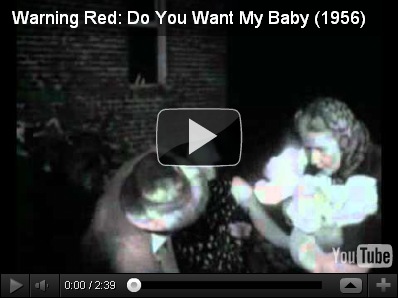
During Dale’s journey—that seems to take less than five minutes of dramatic time—he encounters a stunned family sitting at a table by candlelight, a man cooking milk on an open fire and a psychotic woman trying to give her baby away. He finds his beloved wife, Karen, and son, Davey, when his older neighbor, Mrs. Gray, appears out of nowhere and leads him and his radioactive clothes into her secret (and giant) bomb shelter. There the Dale family is happily reunited while Mrs. Gray cradles the crazy woman’s infant.

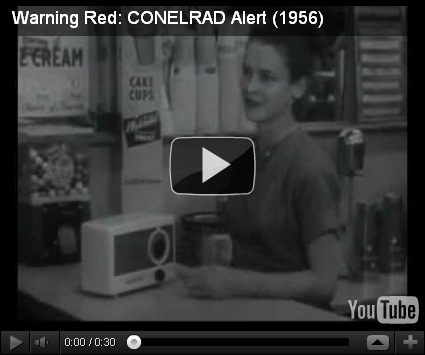
The official coda to the movie is that “You will have a greater chance of survival in an enemy attack or natural disaster if you know what to do…To learn how you can best protect yourself and your family in such an emergency, contact your nearest Civil Defense Office.” The unofficial coda to the movie is that these civil defense-loving survivors will soon be eating ice cream again (even if the scoop girl who so brazenly ignored the CONELRAD alert in the first minutes of the film is probably dead).

Although the very entertaining Warning Red was nationally distributed through the auspices of the Federal Civil Defense Administration (FCDA), it is a Maryland movie at its core. The production was filmed at the National Civil Defense Training Center in Olney and its cast—including lead Joseph Cunningham (as Martin Dale)—was made up of local actors from the Sandy Spring Theatre Group. When the movie was completed and ready to screen, it was feted with a Silver Spring premiere and the following press coverage in the Montgomery County Sentinel:

Lo-Sentinel Headline

CD Movie Made in Olney

Warning Red Stars Local Talent, Sites

Twenty Sandy Spring area residents will get a chance to see how they look in the movies tomorrow evening, when “Warning Red,” a Civil Defense Administration motion picture filmed in Montgomery County, has its national premiere at the Viers Mill Theater.

Most of the sequences in “Warning Red” were made at the Olney CD facility and the majority of the cast are members of the Sandy Spring Group, all amateur actors.

The premiere of the film at 8:30 tomorrow evening will have a dash of Hollywood—floodlights bathing the front of the theater, officials of local and Washington Civil Defense offices and the Sherwood High School band.

Joseph Cunningham, a Washington businessman who lives with his wife and three children at Spencerville, stars in the movie.

He appears as a typical suburban homeowner, searching for his family among the flames, smoke and debris that follow an enemy air attack. The film illustrates the things one should do and not do in such a situation.

Other members of the cast include Mrs. James Anderson, Phillip Boyd Martin, Mrs. Mildred Dowd, Mrs. Mary Reading Miller, Fred Joiner, James Sanders, Robert Miller, Rev. David L. Watterworth, Mrs. Marion Sanders, Melvin Scheidt, Mrs. Julia Bailey, Bonnie Bonifant, Elizabeth Cunningham, Richard Cunningham, Elizabeth Anderson, Sam Bailey, Bill Bailey, Sari Hines and Alan Johnston.

“Warning Red” was directed by Nicholas Webster of Manassas, Va., who has won several Hollywood awards for his direction of documentary films.

It was produced for the Civil Defense Administration by Phillip [sic] Martin, of Norwood Studios. Mr. Martin is a former associate producer and film editor for several major Hollywood studios. He won an Academy Award in 1947 for the year’s best short subject, “The House I Live In.”

F. William Hart was assistant producer, and the script was by Kirby Hawkes. The motion picture was produced with the facilities of Capital Film Studios of Washington.

Source: Montgomery County Sentinel, page C8, January 19, 1956

Lo-Sentinel-Photo-Brightened

While most of the talent behind Warning Red faded into obscurity, the film’s auteur, Nicholas Webster (1912-2006), went on to launch the career of Pia Zadora by helming 1964’s Santa Claus Conquers the Martians. The director revisited the Red Planet in 1968 with Mission Mars without the assistance of Kris Kringle or Ms. Zadora. Webster spent most of the rest of his career working in episodic television including directing several episodes of the cult series The New People.

CONELRAD would love to talk to any of the surviving cast and crew members of Warning Red or their family members. If you fit this description, please contact us. If we hear from anyone, we will update this post.

cdfilms_warningred_reunion_

WARNING RED
Norwood Studios Presents
A Webster-Martin Production

Warning Red Titile 
Starring Joseph Cunningham as Martin Dale
Director: Nicholas Webster
Producer: Philip Martin
Assistant Producer: F. William Hart
Photographed by Bert Spielvogel
Script: Kirby Hawkes

Credits

Produced with the cooperation of The Federal Civil Defense Administration at the Capitol Film Studios
Washington, D.C.
Copyright 1956 Norwood Studios

Capitol Film Studios

Sunday, January 8, 2012

SEARCHING FOR THE DOOMSDAY SCRIPT

“For several months our staffs have been discussing the possibility of prepositioning at the Classified Location a suitable script for general broadcast immediately in the event of an emergency. We have also inquired as to the feasibility of prepositioning a recorded message which could be broadcast under specific circumstances.”

-- Excerpt from a government memorandum dated April 22, 1960

Document Callout

On October 21, 2011 historian and longtime friend of CONELRAD David Krugler emailed to us an intriguing and maddeningly incomplete Cold War era document. The 1960 memo with the subject line “Emergency Statements” proves that the United States government considered the use of prepositioned messages by the President for use in the event of a nuclear attack. Unfortunately, the attachment with the “prepared…text” that is so prominently called out by the document’s author is nowhere to be found.

When we asked Professor Krugler if he had the attachment he said that he did not and would have certainly copied it had he seen it in the early 2000s when he was researching his book. CONELRAD immediately hired a highly recommended researcher to go to the National Archives in College Park, Maryland to find the document.

As of this posting, the attachment has not been located in the folder or the box in which Professor Krugler originally found the memo. Our researcher is currently going through additional boxes in the Record Group, but the prospect of finding the “Doomsday Script” does not look promising. But while we are looking for this crucial part of the treasure map that may ultimately lead to the Arthur Godfrey Doomsday Tape (or, perhaps more likely, the Dwight D. Eisenhower Doomsday Tape), we thought we might as well share what we do have.

OUR PART OF THE TREASURE MAP

“Emergency Statements” is dated April 22, 1960 and was issued by Lewis E. Berry (1914-2005), Deputy Administrator of the Office of Civil and Defense Mobilization. It was rewritten by Eugene J. Quindlen (1919-1977), Assistant Director for Government Preparedness, Office of Emergency Preparedness. The intended recipient was Kenneth T. Downs (1909-1991), Assistant Director for Training, Education and Public Affairs for the Office of Civil and Defense Mobilization (OCDM). Dean Pohlenz (1920-1993), one of the signatories, was an official with OCDM. “J. Scott,” one of the cc addressees, is Jack R. Scott (1921-2008), classified location director, OCDM. The document, which resides in Record Group 396, Box 5, Folder “Federal, State and Local Plans” at the National Archives and Records Administration at College Park, Maryland, is presented below along with a transcription.

Presidential Emergency Statements: 4/22/1960 Memo

April 22 1960

Assistant Director for Training, Education and Public Affairs

Assistant Director for Plans and Operations

Emergency Statements

For several months our staffs have been discussing the possibility of prepositioning at the Classified Location a suitable script for general broadcast immediately in the event of an emergency.

We have also inquired as to the feasibility of prepositioning a recorded message which could be broadcast under specific circumstances.

On various occasions rotating personnel to the Site have raised the matter for discussion. Mr. Heslep of the Atomic Energy Commission has prepared a possible text, the main feature of which is that it does not pretend that the President is delivering it “live.” This seems to be worth serious consideration, and I am, therefore, attaching Mr. Heslep’s material for such appropriate use as you might wish to make.

(SIGNED)

Lewis E. Berry

Attachment

352/JScott/jf/4-21-60/5447
Rewritten: 350/EJQuindlen/kes/x3235/4-22-60
cc:
Central Files – 2
Mr. Berry
Mr. Quindlen
Mr. Scott

[Note: Document is actually signed by E.J. Quindlen and Dean Pohlenz]

Heslep Portrait-Lo

DOOMSDAY’S GHOSTWRITER

The man so notably mentioned in the document as the writer of the sample emergency “text” is a Richmond, Virginia native named Charter Heslep (1904-1963). Heslep, at the time of the memo, was the Chief of the Program Review and Analysis Branch of the Atomic Energy Commission’s Division of International affairs based in Germantown, Maryland. Before the doomsday scribe’s lengthy employment began with the AEC in 1949, he worked in news reporting and editing capacities for the Washington Daily News, NBC, the Mutual Broadcasting System and Congressional News Quarterly. During World War II he served as the chief radio news censor for the U.S. government. Along the way he collaborated on Admiral William D. Leahy’s memoir I Was There [V. Gollancs, 1950] and assisted in the writing of his friend Estes Kefauver’s book, 20th Century Congress [with Jack Levin, Essential Books, 1947].

During Heslep’s long career with the AEC, he witnessed a number of atomic tests and received the strange souvenir “diplomas” presented below to prove it. In 1952 he helped execute the world’s first televised atomic detonation. And in 1955 and 1958 he coordinated press coverage for the Atoms for Peace Conferences in Geneva, Switzerland.

Heslep collage

Heslep also had the opportunity to listen to Edward Teller privately disparage his scientific rival J. Robert Oppenheimer as Teller prepared for his role as a witness against Oppenheimer during his notorious 1954 security clearance hearings. Heslep summarized his conversation with the model for Dr. Strangelove in a memo to AEC Chairman Lewis Strauss. That correspondence is excerpted on pages 532-533 of American Prometheus: The Triumph and Tragedy of J. Robert Oppenheimer by Kai Bird and Martin J. Sherwin [Knopf, 2005]. In the memo, Heslep states that it will be difficult to “unfrock [Oppenheimer] in his own church” in summing up Teller’s belief that Oppenheimer still had the backing of the scientific community.

On July 29, 1963 Charter Heslep, who resided in Silver Spring, Maryland, died in a Berkeley, California hospital following a heart attack. He had been in the San Francisco Bay area on a business trip in his role as the Assistant to the Director of Public Information for the AEC. His wife, Margaret, passed away ten years later. CONELRAD was able to locate Heslep’s son, Thomas C. Heslep in Oregon, but not his daughter, Sara, who may or may not live in Florida.

Thomas told CONELRAD that he recalls his father going on an extended business trip to a presidential bunker in the mountains, but that there were “a lot of things [his father] couldn’t talk about.” The son was not surprised to hear that Heslep may have written an end-of-the-world script for President Eisenhower, but stated that he had no direct knowledge of it. When asked if he had any of his father’s papers, Thomas told us that the last remaining family records are in a safety deposit box in Chicago under his only sibling’s control. He believes that his sister Sara, whom he has not had contact with in over twenty years, is deceased and that he is trying to obtain access to the safety deposit box. If there is a doomsday script or recording, it may well be found in a Chicago bank vault, because it doesn’t appear to be anywhere else.*

* CONELRAD has contacted several different institutions that house portions of Charter Heslep’s papers (The Harry S. Truman Library, Oregon State University and the American Heritage Center at the University of Wyoming) and none contain the painfully elusive attachment to the memo featured in this post.

CONELRAD also contacted the Dwight D. Eisenhower Presidential Library where we were told by a senior archivist that they do not have any material on “Emergency Messages.”

When we asked the Department of Energy to check their AEC records on correspondence by Charter Heslep for the period in question, we were told that nothing on Heslep or the topic of prepositioned emergency messages could be found.

NOTES

CONELRAD derived its biographical information on Charter Heslep from the following sources:

Interview with Thomas C. Heslep conducted by Bill Geerhart on October 25, 2011.

“Charter Heslep, AEC Executive (Obituary),” Washington Post, July 31, 1963.

Biographical Sketch, Charter Heslep, Charter Heslep Papers, President Harry S. Truman Presidential Library Website: http://www.trumanlibrary.org/hstpaper/heslep.htm

Biographical/History Info, Charter Heslep, Charter Heslep Papers, American Heritage Center, University of Wyoming: http://uwcatalog.uwyo.edu/record=b3362610~S3

Biographical Information contained at the conclusion of “They Said It Couldn’t Be Done: The Story of the First Live Televising of an Atomic Detonation” transcript of an address by Charter Heslep on May 9, 1952: http://web.mac.com/zcleve/KlausTribute/AbombHeslep.html

Atomic “Diplomas” accessed from the Charter Heslep Papers at Oregon State University.

ACKNOWLEDGEMENTS

CONELRAD is once again indebted to David Krugler for providing us with such a fascinating lead. If we ever find the attachment containing the Doomsday Script, he will be the first to know. And you’ll be second.

Thanks to Michael Ravnitzky for his assistance in identifying “J. Scott” in the memorandum. 

Thursday, October 27, 2011

A Time for Choosing: Citizen Reagan’s Viewer Mail

Reagan-Pointing-2

It was forty-seven years ago today that a fading film and television actor named Ronald Reagan injected a much-needed jolt of electricity into the flailing Barry Goldwater presidential campaign. On October 27, 1964 at 9:30 P.M. Reagan appeared on the NBC television network in a pre-recorded thirty-minute address entitled “A Time for Choosing.” The speech (aka “The Speech”) launched the future president’s political career and, among conservatives, has achieved a near mythical status.

For the past year CONELRAD has been researching a comprehensive history of this famous broadcast. And while we are not quite ready to post a completed article, we thought we would observe the occasion of this anniversary by sharing some of the reactions that the Great Communicator received in the days after his televised pitch for the Republican nominee first aired nationally.

Standing O-1

What follows are a few selected telegrams that CONELRAD obtained from the Ronald Reagan Presidential Library and Museum. Out of what was purported to be thousands of such responses, only a few dozen were preserved. Of these, all are gushingly admiring (Evidently, the Democrats who might have been inspired to write complaint letters were watching Petticoat Junction on the other channel).

John Ford

We thought we would start our presentation with multi-Academy Award-winning film director John Ford’s succinct rave for Citizen Reagan’s speech:

Lo-John Ford-Reagan-Telegram
Next is conservative icon Phyllis Schlafly’s sister-in-law, Eleanor Schlafly: 

Lo-Schlafly-Reagan-Telegram

Dean Burch, the Goldwater loyalist who was installed as the Chairman of the Republican National Committee after the Arizona senator won the GOP nomination, weighed in with this praise:

Lo-Burch-Reagan-Telegram

Lo-Burch

Burch, it appears, was the only member of the so-called Arizona Mafia to thank Reagan for his speech. Other members of the inner circle, namely Denison Kitchel and William J. Baroody, actively tried to stop A Time for Choosing from airing. The motives ascribed to them for this action vary, but most accounts cite their nervousness over Reagan’s remarks on Social Security.

The next telegram comes from F. Clifton White, the architect of Goldwater’s stunning nomination victory. White, who had wanted to become RNC Chairman, found himself inexplicably marginalized during the general election campaign.

Clifton White 
Lo-White-Reagan-Telegram

We chose this next missive because we liked the writer’s expression “Uncle Goldie.”

Lo-Uncle Goldie-Reagan-Telegram

And we decided to conclude our sampling with Ms. Wilma Batz of Peoria, Illinois who somehow channeled the improbable future and asked: “…I know you’re an actor but are you running for president?”

Lo-Batz-Reagan-Telegram 
It took a while for Reagan to fulfill Ms. Batz’s prophecy, but a little over a year later, on January  4, 1966, the Gipper was back on television announcing his candidacy for the Republican nomination for governor of California.

SOURCE

Ronald Reagan Governor's Papers:
1966 Campaign
Box C35
Folder "66: 'The Speech' 1964 (Telegrams in Response)" 1
Folder "66: 'The Speech' 1964 (Telegrams in Response)" 2
Folder "66: 'The Speech' 1964 (Telegrams in Response)" 3
Ronald Reagan Presidential Library and Museum

Reagan Speech Ad

Sunday, October 23, 2011

A PRIEST, A RABBI AND A MINISTER WALK INTO MOUNT WEATHER…

Day After Clergyman

The Continuity of Government planners were not stupid. In addition to stocking the “Classified Facility” (Mount Weather[1]) with food, water and every other imaginable accoutrement necessary for surviving a nuclear war, they recognized the need for a full compliment of clergy.

Mount Weather Needs Clergy: 10/21/1960

This fascinating document[2] from the director of the Office of Civil and Defense Mobilization, Leo A. Hoegh (1908-2000), dated October 21, 1960 requests that a priest, rabbi and minister be assigned to Mount Weather in a time of crisis. The bureaucratic language of the missive avoids reference to why clergy would be needed, but the author does note that civilian religious professionals might be otherwise occupied during an emergency. These particular men of God would also be difficult to vet for entrance to the super-bunker. Or, as Hoegh puts it: “The security problems involved in bringing in civilians, as you know, are considerable.”

Leo Hoegh

The solution was to ask the Assistant Secretary of Defense for Manpower, Personnel and Reserve, Charles G. Finucane (1905-1983), for “chaplains from either the Regular or Reserve Corps” of the U.S. military. Hoegh sums up his letter with the data-supported spiritual requirements: “Surveys of the emergency population at the Classified Location indicate that one Protestant, one Jewish and one Catholic clergyman would meet our needs.”

Evidently, Mr. Hoegh’s clergy requisition went directly to the circular file, because more than two years later, the chaplain gap was still an issue of concern in Mount Weather correspondence.[3] We can only pray that Mount Weather now has the religious staff it needs, but it will be up to future historians to find out.

ACKNOWLEDGEMENT

CONELRAD would like to thank historian and author David Krugler for thinking of us when he came across this document in his research files.


[1] The evidence that the document is referring to Mount Weather is the fact that the Classified Location’s Chief, J. Leo Bourassa (1917-2000), is one of the co-signatories. For more on Bourassa and his role at Mount Weather see Ted Gup’s August 10, 1992 Time magazine cover story, “The Doomsday Blueprints.”

[2] Letter to Charles C. Finucane from Leo A. Hoegh RE: Chaplain Service for the Classified Location. October 21, 1960. U.S. National Archives, Records Group 396, Records of the Office of Emergency Preparedness, Selected OCDM Files, 1959-1960.

[3] See Memorandum to Colonel Justice J.M. Chambers from Robert Y. Phillips RE: “Special Facility Preparedness,” November 29, 1962, U.S. National Archives, Records Group 396, Declassified P95 Records, Accession 66A03, Box 6, Folder “Special Facilities Branch.”